

Jon here… first off… yes - we’ve rebranded our newsletter and substack from our company names to our personal names … Jon Macaskill and Will Schneider. We feel this gives a more connected community experience and we appreciate you all staying with us through this journey!
Now… onto the article…
I spent years thinking mindfulness was about calming down. Breathe, relax, lower your shoulders, feel better. That’s the version most people get sold, and it’s the version I believed for a long time even while I was teaching it. And it CAN help with that … but…
it turns out the more interesting story is happening one nerve deeper, and the science on it has gotten good enough that I want to walk you through it.
So let’s start with the nerve.
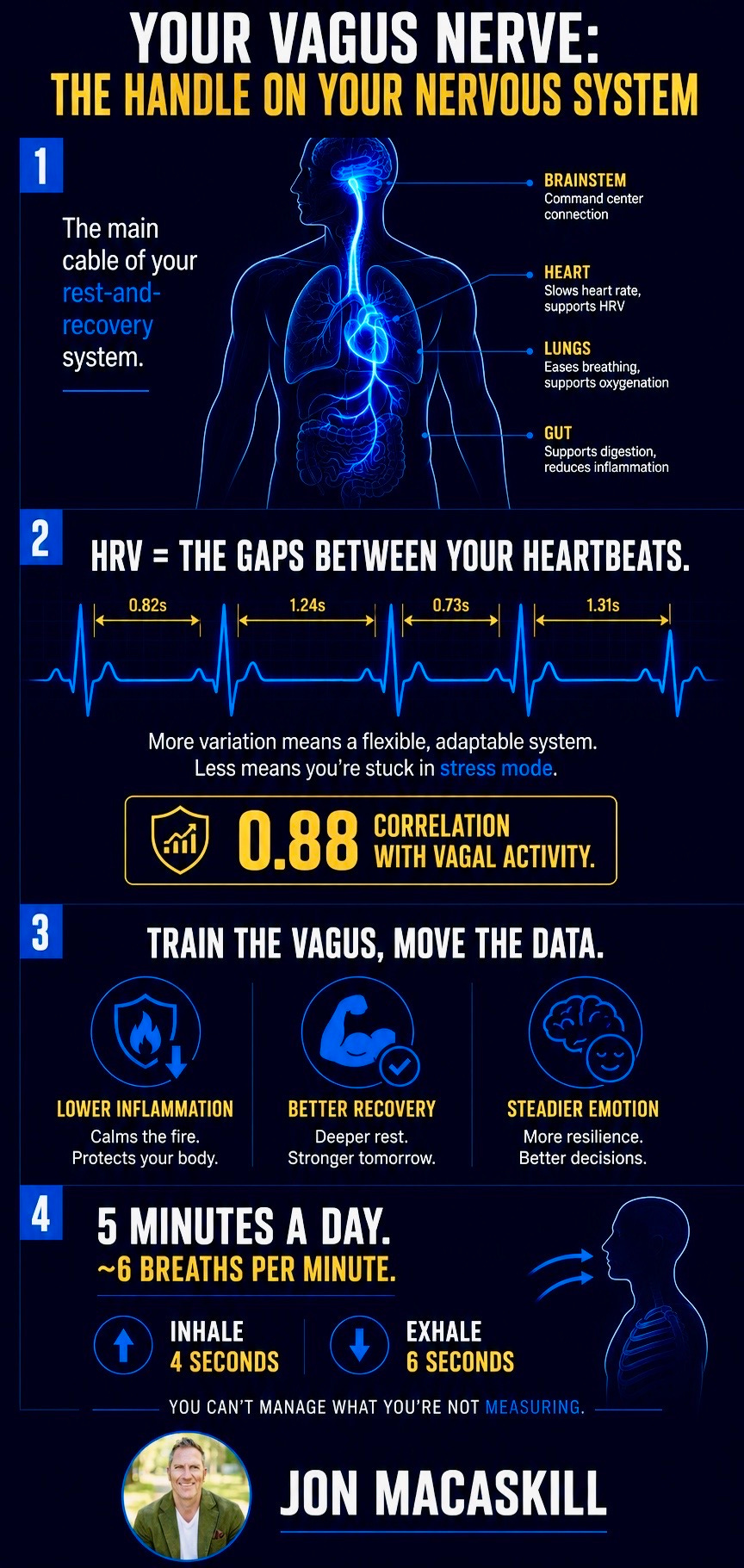
Your vagus nerve runs from your brainstem down into your heart, your lungs, your gut. It’s the main cable of your parasympathetic nervous system, the side that handles rest, digestion, and recovery. When people talk about getting your nervous system “hijacked” under stress, what they’re really describing is the other side of our nervous system… the sympathetic side taking over and the vagus going quiet. The whole game of regulation is getting that vagus back online.
Here’s the part that turns this from a feeling into something you can actually measure. There’s a number called heart rate variability, or HRV. It’s the tiny variation in time between your heartbeats. Your heart isn’t a metronome, even at rest the gaps between beats shift slightly, and that shifting is a good thing. More variation means your system is flexible and can adapt to whatever’s coming. Less variation means you’re locked in one gear, usually the stress gear. HRV tracks vagal activity so closely that researchers use it as a stand-in for what the vagus is doing, with a correlation around 0.88.[^1] That’s tight.
Now to the good stuff for those of us who chase performance.
A 2025 review in Medicine International by Gitler and colleagues lays out how you raise vagal tone with paced breathing, slow breaths at your own resonance frequency, usually around 6 a minute.[^1] Do that consistently and you strengthen your baroreflex, the reflex that manages blood pressure beat to beat. You calm systemic inflammation. You improve emotional regulation. They show up in bloodwork and in recovery data.
Now as I’m getting older and… more sore… the inflammation piece is the one that got my attention. There’s a documented pathway, the vagal anti-inflammatory reflex, where vagal activity signals the body to dial back the cytokines that drive chronic inflammation.[^2] Animal models showed it first, then human data from a large study called MIDUS II backed it up: higher HRV, lower inflammatory markers.[^2] So the breathing you do in the morning isn’t just changing your mood. It’s reaching into a system that touches heart disease, metabolic health, and how fast you recover from hard training.
And it runs both directions. The newer framing is the brain-heart axis, a two-way street where your brain modulates your heart’s rhythm and your heart sends signals back up that shape your emotions and your thinking.[^3]
Same review notes HRV also tracks with waist circumference and cardiometabolic risk.[^3]
One lever, a lot of outcomes.
There’s a model some researchers call NISIM, short for the Neuro-Immuno-Senescence Integrative Model.[^4] The claim is that how well your prefrontal cortex regulates your vagus under stress feeds all the way down through your spleen to your inflammation levels and eventually to telomere damage, which is a marker of cellular aging. Plain version: how you handle pressure may show up in how fast you age at the cellular level.
I love that idea. It’s still a model and the research is early. And to be fair to the whole picture, a 2025 study in depression patients found no clean link between cytokines, HRV, and the physical structure of the vagus nerve, so this isn’t all settled science.[^5]
What to do with this today…
Here’s what I take from all of it. The breathwork isn’t woo. When you run a physiological sigh, two inhales through the nose then a long exhale, or a few rounds of box breathing, you’re pulling a real lever on a real system. You’re training your vagus the way you’d train a muscle. The breath is the handle, and now we can watch the system move on the data.
You can’t manage what you’re not measuring. If you’ve got a Garmin, a Whoop, an Oura, anything that reads HRV, you’re already holding a window into this. So try this:
1. Watch your morning HRV for 2 weeks. Just look. Get a baseline.
2. Add 5 minutes of slow breathing a day, around 6 breaths a minute. Inhale for about 4 seconds, exhale for about 6.
3. Watch the number over the next month.
You won’t get a straight line up. Sleep, booze, stress, and training all push it around, and that’s the point, it’s responsive. But the trend is what matters. Give your vagus a reason to come online every day and it tends to show up.
Want help doing this? We’ve built an app to do just that!
https://focusnowtraining.com/get-the-app-page
-----
[^1]: Gitler A, Bar Yosef Y, Kotzer U, Levine AD. “Harnessing non-invasive vagal neuromodulation: HRV biofeedback and SSP for cardiovascular and autonomic regulation (Review).” *Medicine International* 5, no. 4 (2025): 37. <https://www.spandidos-publications.com/10.3892/mi.2025.236>
[^2]: Williams DP et al., on heart rate variability and inflammatory markers via the vagal anti-inflammatory pathway, MIDUS II data. <https://pmc.ncbi.nlm.nih.gov/articles/PMC4476948/>
[^3]: “Heart rate variability: a multidimensional perspective from physiological marker to brain-heart axis disorders prediction.” *Frontiers in Cardiovascular Medicine*, Vol. 12, 2025. <https://www.frontiersin.org/journals/cardiovascular-medicine/articles/10.3389/fcvm.2025.1630668/full>
[^4]: “Prefrontally Modulated Vagal Tone Inhibits Inflammatory Responses to Prevent Telomere Damage” (Neuro-Immuno-Senescence Integrative Model). <https://www.biorxiv.org/content/10.1101/2022.02.17.480574.full.pdf>
[^5]: “No relationship between inflammatory cytokines, heart rate variability, and morphology of the vagus nerves in patients with major depressive disorder.” 2025. <https://pmc.ncbi.nlm.nih.gov/articles/PMC12140965/>
The power of the breath and what can result mentally, physically, and spiritually when consciously managing it never ceases to amaze me. Love your word of resonance too. Great article