


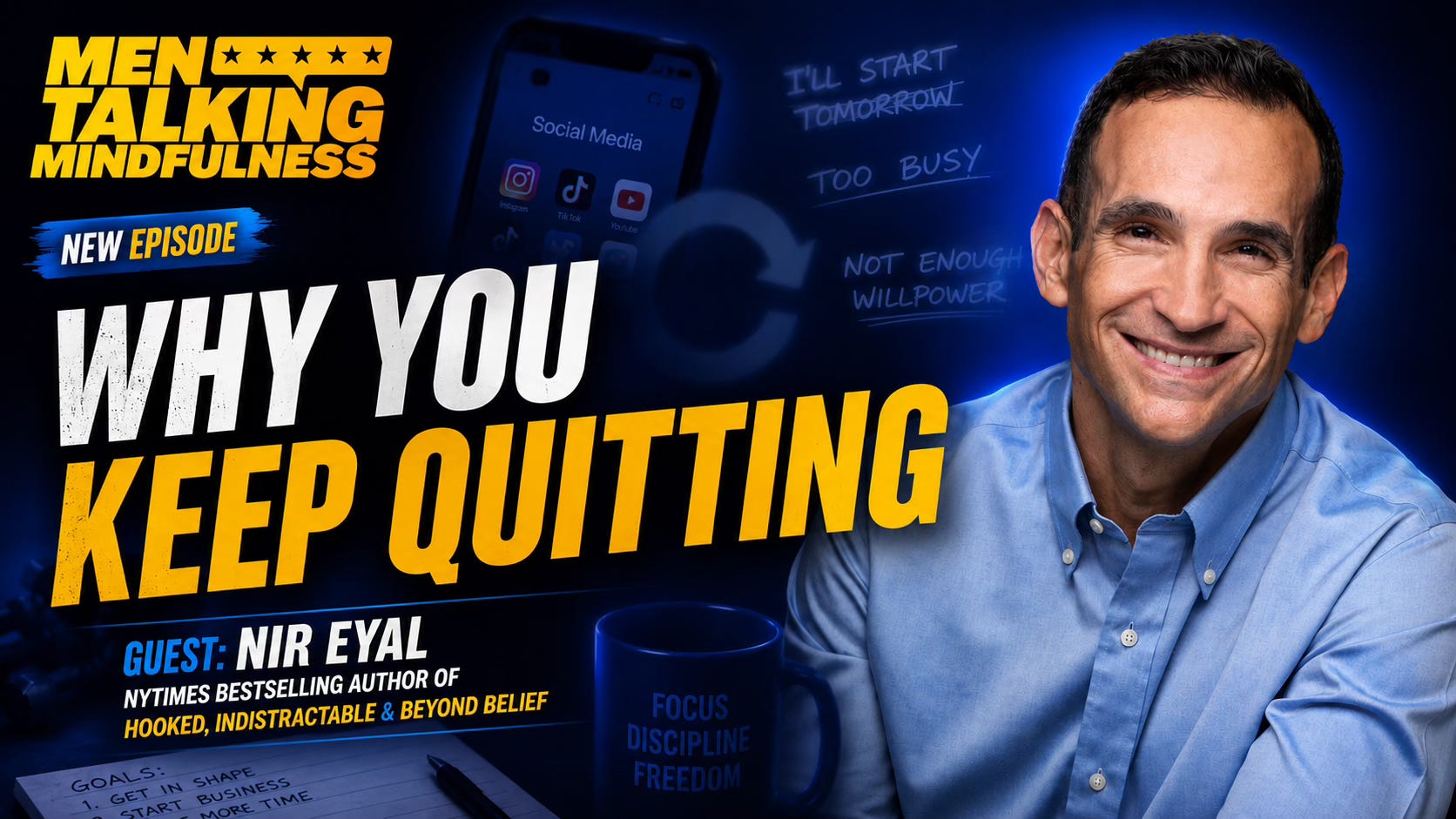
Jon opened this week’s episode with a question most people have felt but never said out loud: you’ve read the books, nodded along, agreed with every word in them, and then changed nothing. What’s actually going on there?
Our guest is Nir Eyal. Author of Hooked (the book about building products that capture your attention), then Indistractable (the book on how to resist some of those same systems), and now Beyond Belief, which goes into the deeper layer underneath both of them. Why do we know exactly what to do and still not do it? Nir spent six years on that question. He had a real answer.
90% of your distractions don’t start with your phone.
Only 10% of the time you reach for your phone is because of a notification. The other 90% is because of what Nir calls an internal trigger: an uncomfortable emotional state you’re trying to escape. Boredom, loneliness, fatigue, anxiety, uncertainty. That’s the actual source. The phone is just the vehicle available in that moment.
The implication matters. You can delete the apps, leave the phone in another room, turn off every notification. And the feeling that drives distraction will still be there, looking for something else to climb into. The vehicle changes. The feeling underneath stays. Which is why any approach to distraction that only targets the technology is solving for the wrong variable.
The motivation triangle has a third leg most people never see.
The conventional model of motivation is a straight line: if I want the benefit, I’ll do the behavior. Classic economics. But Nir says there’s a third element most people never account for: belief. You have to believe the benefit is actually available to you. And you have to believe you’re capable of the behavior. Without that, the structure collapses.
His finding from the research: the number one reason people don’t meet their long-term goals is that somewhere along the way, they stopped believing it was going to work. And once that belief goes, quitting follows. As Nir put it: “Quitting guarantees failure. Perseverance doesn’t guarantee success, but quitting is the one guaranteed way to lose.”
Beliefs are tools, not truths.
Nir draws a line between facts, faith, and beliefs. Facts are objective (the world is not flat). Faith is conviction that doesn’t require evidence, and almost never changes. But beliefs sit between those two. A belief is a conviction that’s open to revision based on new evidence. They can be changed. That’s what makes them so important.
There’s a story in the book about a man called Mr. A, a research subject who overdosed after a bad breakup. He took an entire bottle of what he believed were antidepressants. By the time he reached the ER, he had dangerously low blood pressure, a falling heart rate, and was fading in and out of consciousness. Real physiological symptoms, textbook overdose presentation. Except he was in the control group of an antidepressant trial. The bottle was cornstarch placebos. 15 minutes after they told him the truth, his vitals returned to normal and he walked out fine. His beliefs had literally become his biology.
On the other end: a Yale study found that people with positive beliefs about aging lived 7.5 years longer. More than the effect of diet. More than exercise. More than quitting smoking. From belief alone.
And the identity piece, which is where this gets personal. Nir has ADHD. The diagnosis was useful at first: it explained something that had been hard to name. But over time, every time Nir got distracted, his brain went straight to: chronic brain disease, never going to fix this, I can’t do this like other people can. That story took him further from the task he was trying to do. So he changed the script. The diagnosis is a map, he says. It shows you where you are. A map isn’t your identity, and it doesn’t tell you where you have to stay.
Psychologists call it identity foreclosure when a label or diagnosis becomes so fixed that you stop looking further. You tunnel your entire experience through it. I’m this way because of this thing and that’s that. The question worth asking: is that a fact, or is it a belief? Because if it’s a belief, it can change.
The rats swam for 60 hours.
Richter’s experiment in the 1950s. Wild rats dropped into a cylinder of water swam for about 15 minutes before giving up. Then he took a second group, let them swim to the 15-minute mark, pulled them out just as they were starting to struggle, let them rest, and put them back in. How much longer did the second group swim? 60 hours. 240 times longer. Same rats, same cylinder, same challenge. The only variable was that the second group had experienced rescue. They had reason to believe that if they kept going, something might change.
Jon connected it to SEAL training. Some of the strongest men he’d seen, genuine physical specimens, would ring out early. And watching them leave, he said, his own belief actually grew. Not because the physical challenge got easier. Because the story about what was possible shifted. Richter’s experiment is not about rats. It’s about what becomes available when you believe the hand might reach in.
The full conversation is up now. Audio: pod.fo/e/412ab7. Video is available on Spotify now and will be on the Valor Media Network YouTube channel later Thursday.
This week’s newsletter has 3 practical tools from the conversation below: the internal trigger log, the belief audit, and the time-boxing practice.
And if this conversation hits close to home, it goes deeper in Module 4 of our Awareness to Action course (Noticing Thoughts and Emotions). Head to focusnowtraining.com/a2a-course-interest or text A2A to 33777 to stay in the loop.
Full newsletter archive: newsletter.focusnowtraining.com or text MTM to 33777.
Nir Eyal’s free 5-minute belief change guide: nirandfar.com/beyondbelieflive
