

Hey all, real quick note before we get into this. You’ll see this is now coming from Jon Macaskill and Will Schneider rather than Focus Now Training. We still run FNT and FNT’s podcast (Men Talking Mindfulness) but we wanted to make this more personal… so we changed it to our names. Hope you will stay subscribed even with the messy change. We appreciate you… now, let’s get into it…
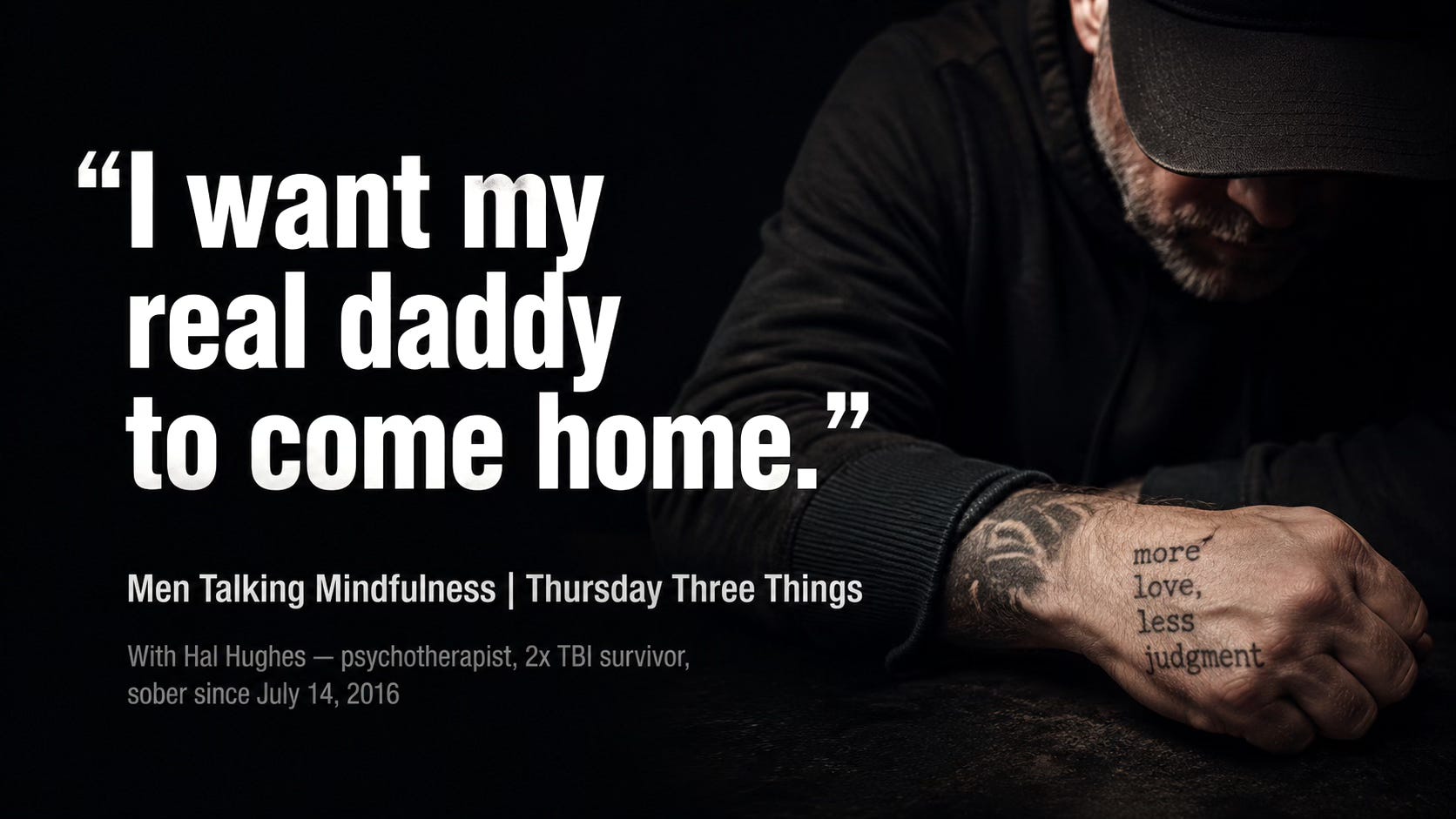
“I want my real daddy to come home.”
Hal’s youngest son said this to him. The boy was maybe 3, maybe 4. Hal’s wife had been trying to explain to him why daddy wasn’t tucking them in at night anymore, why he wasn’t reading stories, why he wasn’t the same dad he’d always been. The boy resolved something in his small mind, looked at Hal dead in the eyes, and said it.
8 words.
Within 18 months, Hal was back on full duty as a police officer, despite clinicians who had told him he’d probably never work again.
Motivation comes from motive: the reason why. If the why is big enough, you figure out the how.
Hal Hughes spent years before that moment as a cop, a black belt in jiu-jitsu with plans to turn pro in MMA, a marathon runner, a highly engaged father of 3 with a 4th on the way, and someone who thought he was roughly bulletproof. Then January 2, 2008: on duty in his cruiser, waiting to turn left on a highway, the sun setting directly in front of him. The car behind him was blinded by the sun, didn’t slow down, and hit him at a speed that totaled the cruiser. His head took the impact off the steering wheel. “Mild” traumatic brain injury, the initial diagnosis said. Within weeks he’d gained 40 pounds, was sleeping 20 hours a day, had migraines 5 or 6 days a week, couldn’t drive, and was suicidal. And then his son said those 8 words.
The sharpest instrument in an unsteady hand
Hal tells a story about a young man who wants to be a chef. Goes to find the master chef in the area, begs for a job, gets told: your first year, all you do is chop vegetables. The chef hands him a knife very carefully. “This is Henckel, surgical steel, razor sharp. This is not the knife at home in your parents’ kitchen. Be careful.” Kid says yeah yeah, sure. Half a day in: he chops his finger off.
The brain is the sharpest known instrument. In an untrained, unsteady hand, it cuts the one holding it: anxiety, depression, addiction. And it cuts the people around them: anger, frustration, the low-grade chronic reactivity that damages relationships slowly over time. When the pain of holding it wrong becomes too much, people do what humans have always done with pain. They find the fastest available way to change their state. Drugs. Alcohol. Netflix. Scrolling. Anything that doesn’t require work and produces some relief.
Hal’s TBI got him a prescription for 30 milligrams of codeine for the migraines. The codeine didn’t much help the pain, but it gave him energy and something close to mood. He didn’t know that was a thing. Within a couple of months, the 30-milligram prescription had become black-market oxycodone and hydromorph, whatever he could access. 2 overdoses. Suicidal again. An NA meeting he attended while high on opiates, looking around the room thinking he wasn’t like these people -- he was a cop, a family man, a martial artist. Second meeting, same. Third meeting, something shifted. “Hi, my name’s Hal, and I’m an addict.” This time he meant it.
People get addicted because they’re in pain. Usually emotional pain they’re trying to soothe. That’s the starting point for any honest conversation about this.
The 500-horsepower engine going the wrong way
Hal’s worked with enough men in recovery to know what consistently fails: trying to willpower through it. The high-performing men especially. “I have a 500-horsepower engine,” goes the logic. “I can outpower this.” The problem, Hal says, is that a 500-horsepower engine going the wrong way up a one-way street does the most damage.
He talks about a study called Rat Park, done by Dr. Bruce Alexander. Put a rat in an isolated cage with 2 levers: one delivers food, one delivers cocaine or opiates intravenously. Some rats will sit there hitting the cocaine lever until they starve to death. They just choose it over food, repeatedly, until they’re gone. Then take that same kind of rat and put it in a large, enriched space with room to move, natural materials to manipulate, other rats to interact with, the full social and physical environment a rat needs to function. Give it the same 2 levers. The rat tries the food, tries the substance. And rarely ever gets addicted, irrespective of its DNA.
Addiction doesn’t happen in isolation, and it doesn’t get fixed in isolation. The path out runs through community. Specifically: one person who’s a little further down the path looking back and saying “come this way, I know the path.” That’s what NA and AA do. No clinicians leading it, no prescriptions. Just one addict or alcoholic who’s been where you are, still standing, pointing at the way through.
Hal’s seen a lot of clients in his work. He’s yet to see one get clean alone. Not one.
The man who headbutted him in the ER
4 years after the first TBI, Hal was on duty when an arrested suspect, drunk and violent, handcuffed on a hospital gurney while he was being stitched up, waited for the one moment Hal relaxed his grip and threw his whole body backward. Reverse headbutt. Hal went out on his feet. The floor of the ER caught the secondary impact. He’s a cop who got head-injured in an emergency room, so they literally picked him up and put him on the next gurney over. The subsequent scans and follow-ups showed bilateral permanent frontal lobe damage. Frontal lobe damage brings emotional dysregulation. Which brought more psychiatric medications than I’ll list here, and eventually the full spiral into addiction.
The man who gave him that second TBI ended up facing criminal charges. And Hal was invited to a community justice forum, which is a restorative justice process common in Aboriginal cultures where victim and accused sit in a circle with a court mediator and attempt to reach a binding agreement before the matter goes to trial. Hal’s wife didn’t come. She would have attacked the man. Hal went. And he admits that somewhere in the back of his mind, he wondered if he might get a chance to do the same.
He sat there staring at the floor, unable to look across the circle. He described the events of that day and then the impact: the second TBI, the frontal lobe damage, what it had done to him as a father, a husband, a son, a brother. He was still staring at the floor when he heard a noise from the other side. He looked up. The man was sobbing. And everyone who’d come to support him, every person on that side of the circle, was sobbing with him.
Hal said that change is usually a dimmer switch. But sometimes it’s on-off. He stood up, crossed the circle, asked the man to stand. The man probably expected to get hit. Hal hugged him. And said: I forgive you. The only thing you owe me going forward is please try to show someone else a little more love and a little less judgment in your own life.
As part of the binding conditions: treatment for the man’s addiction, and coffee with Hal every couple of months.
I was tearing up listening to this. It’s real and it costs something. And the thing Hal said afterward stuck with me: he thinks part of what drove him there was wanting to be free. If he could turn an enemy into a friend under those circumstances, if he could show more love and less judgment in that moment, he knew he could do it anywhere.
More love, less judgment. He has it written on his hand.
What to do about it
Find the reason why and make it specific. Motivation comes from motive. Hal’s son gave him his with 8 words. Vague wanting to feel better doesn’t hold when the hard days come, and the hard days come. Who specifically needs you to show up as your real self? What specifically are you not being that you know you’re capable of? Write it down. Keep it visible.
Look at the environment before you fight the behavior. The Rat Park study says it plainly. The conditions around you shape your behavior more than discipline alone. Before the next round of white-knuckling, ask: what’s missing from the environment? Where’s the community? Where’s the meaningful challenge? Where’s the purpose? The park has to be built, and it gets built one piece at a time.
Get the vehicle right before trying to drive it. Hal tells his clients: become an athlete. Just someone who sees themselves that way and builds habits around that identity. Sleep, nutrition, movement: in roughly that order of importance, these are what determine whether the mind has anything to work with. You can’t execute psychological tools in a physiologically compromised body. A 2016 Harvard study found 8 weeks of consistent mindfulness practice structurally changes the brain: increases thickness in the hippocampus and emotional regulation centers, decreases size in the amygdala. But the vehicle underneath all of it still has to be maintained.
Try “strict with self, tolerant of others” for one week. Hal calls this a cornerstone of Stoic philosophy. Strict about how you run your physiology, how you treat people, how you use the instrument you’ve been given. Tolerant of what your fellow humans bring. All 4 clauses, not just the “strict” half. See what happens.
Start sparking. Toward the end of the episode, Hal told us about an elderly woman he met at a gathering. She’d been in an abusive marriage for over 50 years, isolated from family and friends by her husband. When he died, she made a decision: she was going to connect with anyone and everyone she could, wherever she was. The checkout clerk. A stranger on the sidewalk. Someone at a party willing to really talk. She called it sparking. She told Hal: “With all those little sparks, surely my life will have been filled with light.” Make eye contact. Say the thing. Spark.
This week on Men Talking Mindfulness
Will and I sat down with Hal Hughes: former corrections officer, police officer, and now psychotherapist who works specifically with first responders and the military. 2 traumatic brain injuries, a bipolar and PTSD diagnosis, opiate addiction, 2 overdoses, sober since July 14, 2016, and coming up on 10 years. He’s earned every bit of what he brings to this conversation, and it goes places most conversations on this stuff don’t.
Watch on YouTube | Listen here
Everything below here is for paid subscribers… get full access by becoming one yourself and gain 15% off our Awareness to Action Course!!
