

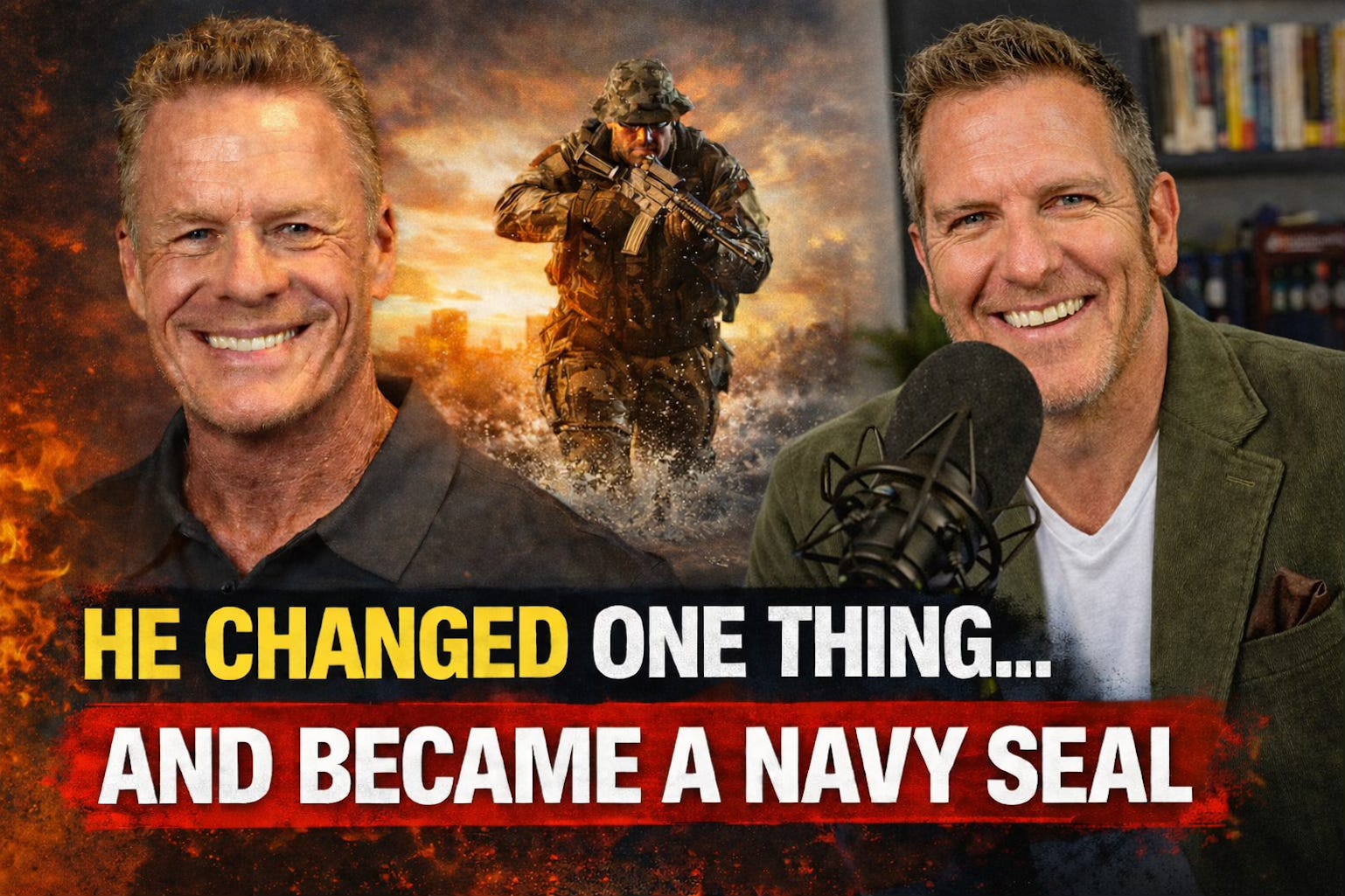
Welcome to the Listener’s Digest Audio Version of our Newsletter. This audio version is read by AI and is a weekly shorter version of our Thursday Three Things newsletter, put out by Focus Now Training, the parent company of the Men Talking Mindfulness podcast. Each week we take one of our former newsletter editions and give you the highlights in a format you can listen to on a walk, a drive, or wherever you’ve got a few minutes. This week’s edition is based on one of the most personal ones we’ve put out, with a guest whose story drew more response than almost anything we’ve published... and enough of you asked for it back that we’re bringing it around again. This one’s with Commander Mark Divine, former Navy SEAL, founder of SEALFIT, and one of the few people Jon has ever called flat-out uncommon. And that’s saying something.
Here’s the short version of how Mark got to where he is.
1985. He’s 21 years old, working at a New York accounting firm during the day, studying for his MBA at NYU at night. Corporate track. Everything on paper looking the way it was supposed to look. And then one evening he’s walking down 23rd Street and he hears screaming coming from the second floor of a building. He stops, looks up, and there’s a sign that says World Sato Karate Headquarters. He goes up. And standing in that room is a man named Tadashi Nakamura, a ninth-degree black belt, founder of the style, and by Mark’s own words, the complete opposite of his father in every way that mattered.
Mark grew up in an abusive home. A lot of rage. A lot of alcohol. He’d found solace in endurance athletics because physical training was the one place he had control. He says the seeds of the Navy SEAL were forged in the fire of his father’s abuse and in turning toward the discomfort of hard physical work. Coleman Ruiz made a similar observation on Andrew Huberman’s show, that a surprising number of BUDs graduates came from broken homes, or had been in trouble, or had something to prove that ran deeper than ambition.
What Nakamura introduced Mark to wasn’t just karate. It was Zen. Sitting on wooden benches, eyes closed, focusing on the breath. Inhale, count one. Exhale, count two. Try to get to ten. Mark says it took him about a year and a half before he could credibly say he thought he might have made it to ten. And even then, he probably started thinking about the fact that he was close to ten right around eight.
But here’s what that practice opened up. Somewhere in the middle of learning to hold attention on one thing, he noticed something he couldn’t quite explain. He noticed that he was watching his own thoughts. And if he was watching his thoughts... who was doing the watching? That question, once it lands, doesn’t go away. Mark calls it the first major shift. You realize you are not your thoughts. You are something behind them, something that observes them. And when that clicks, the story you’ve been telling yourself about who you are starts to look different.
For Mark, the story he’d been telling himself was CPA, MBA, corporate track, not good enough. The story that came from the other side of that observation was something else entirely. One word: warrior.
He started visualizing BUDs before he was even accepted. He’d watched the Navy recruiting video twenty times until he could insert himself into the imagery. He practiced the training in his mind every day after his run. About nine months in, he felt a shift. Went from hoping and wanting and wishing to a state of flat certainty. Two days later his recruiter called to tell him he’d gotten a billet. Mark says he wasn’t surprised. The recruiter said, you know, you guys are weird, you’re going to make great SEALs.
He graduated as the honor man in BUDs class 170. 185 people started. 19 finished. And Mark led his entire boat crew of seven through with him.
The model he teaches now is what he calls the five mountains: physical, mental, emotional, intuitive, and spiritual. The physical comes first because you can’t do the inner work if the body is a wreck. Breath control is the entry point. Get control of your physiology and you have a fighting chance at getting control of your psychology. From there, attention control. Then positive mental management. His BUDs mantra, the one he repeated every swim and every run, was this: I’m feeling good, I’m looking good, I ought to be in Hollywood. Doesn’t matter where it came from. It worked.
And the leadership piece. Someone asked Mark what the secret was to leading six men through one of the hardest selection programs in the world. His answer … the best leadership quality is demonstration. Show me, don’t tell me. Not technically. but In terms of character. Be the leader you would have wanted to be led by.
Mark’s got a metaphor for the inner work that stays with you. He talks about the difference between being on the surface of the ocean in a storm versus being three hundred feet down. The surface is noise, chatter, reaction. Three hundred feet down is utterly still. Meditation, in his view, is what moves your center of gravity down toward the still water. The storm is still happening. It just stops running you.
Full newsletter is at newsletter dot focusnowtraining dot com. Or text MTM to 33777. If this one hit you differently than you expected, that’s kind of the point. Pass it on.


